



Your Body Has a Built-In Appetite Control System – Here’s What Powers It
This article discusses emerging/ongoing science and research. It is intended for general informational purposes only. This content is unrelated to products offered by Organixx and does not contain any representations about the performance of such products.
In a hurry? Click here to read the Article Summary
You’ve eaten a full meal. But something still feels unsettled – a low-level urge to keep picking, a pull toward the kitchen even though you know you don’t need anything else. An hour later you’re craving something sweet. By mid-afternoon, your appetite feels like it’s running on its own agenda.
This isn’t a willpower problem. It’s a communication problem – between your gut and your brain. And the good news is that your body already has a sophisticated system designed to manage it. The question is whether that system is getting what it needs to work properly.

The Gut-Brain Conversation Nobody Told You About
Your gut and your brain are in constant contact. Running between them is a two-way communication network – the gut-brain axis – that operates continuously, sending signals back and forth about what’s happening in your digestive system and responding accordingly.
Think of it as a phone line that never stops buzzing. Your gut is constantly sending updates to your brain: what you’ve eaten, how much energy is available, whether the digestive system is happy or under stress. Your brain processes those signals and responds with instructions – including whether to feel hungry, satisfied, or somewhere in between.
The important thing to understand is that this conversation doesn’t just flow one way. Most people think of appetite as something the brain controls. But the research tells a more interesting story. The gut often leads that conversation – and a well-nourished gut sends clear, reliable signals. A depleted or imbalanced one sends static.
The Signal That Tells Your Brain “That’s Enough”
You know that comfortable feeling of having genuinely had enough to eat – not stuffed, just quietly satisfied, where the urge to keep eating switches off naturally? That feeling has a biological name and a specific mechanism behind it.
It’s produced by hormones – the body’s chemical messengers – released at various points in the digestive process to signal fullness. One of the most important of these is a hormone called GLP-1 (glucagon-like peptide-1), and it’s produced right in the lining of your gut. It is part of your body’s own appetite regulation system – it has nothing to do with medication; this is something your body makes naturally every time you eat.
Here’s what it does: it tells the brain you’re satisfied, slows the rate at which the stomach empties so that fullness lasts longer, and helps keep blood sugar steady after a meal. Together, those three effects make eating feel like it was enough – and keep the urge to keep going quietly switched off for hours.
Think of GLP-1 as the volume control on your appetite. When it’s working well, hunger signals stay at a manageable level – you eat, you feel satisfied, you get on with your day. When it’s not working well, the volume stays up even after you’ve eaten enough, and the signals your brain receives are muddy rather than clear.
So what determines how much GLP-1 your body produces? The answer starts with your gut microbiome – and what you feed it.

How Fiber Starts a Chain Reaction in Your Gut
Your gut is home to billions of bacteria – a vast, living community whose job is to break down what you eat and, in doing so, produce signals that affect everything from your energy levels to your mood and appetite. Think of them as a workforce. Feed them the right things and they produce something genuinely useful. Starve them – or fill the gut with highly processed food they have nothing to work with – and output drops.
One of the most useful things this bacterial workforce produces is a group of compounds called short-chain fatty acids, or SCFAs. These are the natural byproducts of beneficial bacteria fermenting prebiotic fiber – a bit like the useful output of a well-running engine. The engine needs the right fuel; the bacteria need the right fiber.
Here’s where it gets interesting.
Research published in the journal Diabetes identified that SCFAs directly stimulate specialised cells lining the gut wall – called L-cells – to release GLP-1 [1]. A cross-sectional study in Scientific Reports involving 160 participants confirmed that circulating SCFAs were positively associated with GLP-1 concentrations in humans [2].
The pathway, laid out simply, looks like this: Prebiotic fiber feeds your beneficial gut bacteria. The bacteria ferment it and produce chemical messengers. Those messengers trigger cells in your gut lining to release GLP-1. And GLP-1 tells your brain: that’s enough. You’re done.
That chain reaction only works if the right bacteria are present and well-fed. Which is where the type of fiber you consume becomes the key starting point.
What Prebiotic Fibers Actually Do
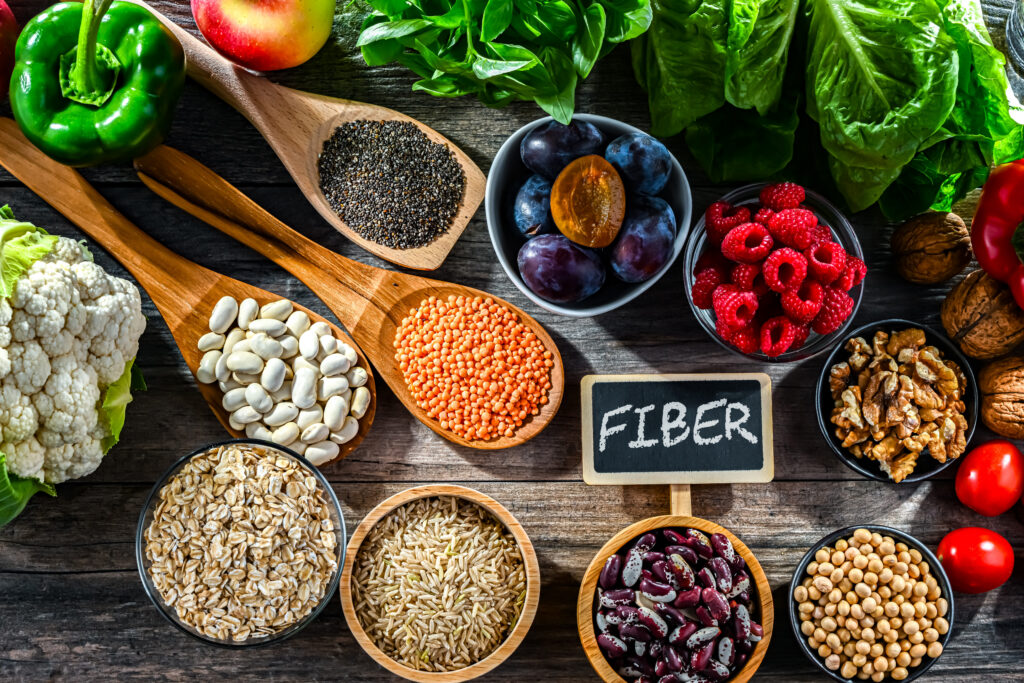
Not all fiber is created equal, and not all of it does this job. Prebiotic fiber is a specific category – dietary fiber that passes through the digestive system undigested and selectively feeds beneficial gut bacteria. Regular fiber is useful. Prebiotic fiber is targeted.
Three types of prebiotic fiber have been particularly well-studied for their effect on the gut bacteria involved in this process:
Acacia fiber is one of the gentlest and well-tolerated prebiotic fibers available. Unlike faster-fermenting fibers that can cause bloating and discomfort, acacia ferments slowly – feeding beneficial bacteria gradually and consistently throughout the digestive tract. Research has shown it significantly promotes Bifidobacterium growth while also inhibiting bacteria associated with gut imbalance, and produces SCFAs including propionate, one of the key compounds involved in the satiety hormone pathway [3,4].
Inulin – particularly from Jerusalem artichoke – is one of the most extensively researched prebiotic fibers in human studies. It selectively feeds Bifidobacterium strains and has been shown in multiple studies to support increased SCFA production. A review published in Nutrients found that inulin delays gastric emptying – meaning food moves through the digestive system more slowly – which directly increases the secretion of satiety hormones and supports steadier blood sugar after meals [5]. A human trial using Jerusalem artichoke inulin specifically confirmed its prebiotic effect on Bifidobacterium populations [6].
Apple fiber provides both soluble and insoluble fiber – a combination that supports digestive regularity and helps moderate the rate at which energy from food is released into the bloodstream. By slowing carbohydrate absorption, it contributes to the kind of steady, even energy release that avoids the blood sugar spikes and crashes that often drive afternoon cravings.
Together, these three fiber types work at different rates and in slightly different ways – but they’re all feeding into the same chain reaction. The bacterial workforce gets sustained nourishment throughout the day rather than one concentrated burst, and the satiety signals to the brain stay consistent.
Why Probiotics Complete the Picture
Prebiotics are the food. Probiotics are the workers. And you genuinely need both.
Think of it this way: you can stock a kitchen with the best ingredients in the world, but if there’s no one there to cook, nothing gets made. Probiotics are the live beneficial bacteria that help maintain and restore the microbial balance that makes the prebiotic fiber pathway function properly.
One important practical consideration is survivability. Most probiotic bacteria face a tough journey – stomach acid is highly acidic by design, and many bacterial strains don’t survive it in sufficient numbers to reach the gut where they’re needed. Strains like certain Bacillus species have a natural advantage here: they’re spore-forming bacteria, which means they exist in a dormant, armoured state that resists the acidic environment of the stomach and the bile salts of the small intestine, arriving in the gut active and ready to work [7,8].
Research on Bacillus species has shown their ability to support a balanced gut microbiome, enhance the production of short-chain fatty acids, improve digestive comfort, and help maintain the microbial environment that allows prebiotic fiber to do its job effectively [9].

What a Well-Nourished Gut Actually Feels Like
When this system is working well, it doesn’t feel dramatic. It feels like things are simply… easier.
Appetite feels proportionate rather than relentless – the urge to keep snacking after meals quietens down naturally, without effort or restriction. Energy after meals feels steadier, with less of the post-lunch slump that comes from blood sugar spiking then crashing. Mental clarity holds up through the afternoon, because the gut-brain line is sending clear signals rather than static.
Research on microbiome diversity consistently links gut health with cognitive function and mood stability – the same axis that regulates appetite also influences focus and emotional balance [10].
This is what a well-nourished gut feels like from the inside. Not a dramatic shift. Just noticeably, reliably better.
Your body has had this system all along. What the research is now showing us, with increasing clarity, is exactly how to support it.
Article Summary
- Your gut produces hormones – including GLP-1 – that tell your brain when you’ve genuinely had enough to eat. This is your body’s own natural appetite regulation system
- The key to supporting it is what you feed your gut bacteria: prebiotic fiber triggers a chain reaction that ends in the release of satiety hormones
- Three prebiotic fiber types – acacia, inulin, and apple fiber – each support this process in distinct and complementary ways
- Spore-forming probiotic strains are particularly well-suited to survive the journey through the digestive system and support the microbial environment that makes all of this work
- A well-nourished gut doesn’t just improve appetite regulation – it supports steadier energy, clearer thinking, and more even mood throughout the day



Comments